

AUTHORS
Christel NAVARRO, Apostolia M. TSIMBERIDOU, Cécile BOUGERET, Dominique BRIDON, Elsa BORGHI, Hélène SICARD
ABSTRACT
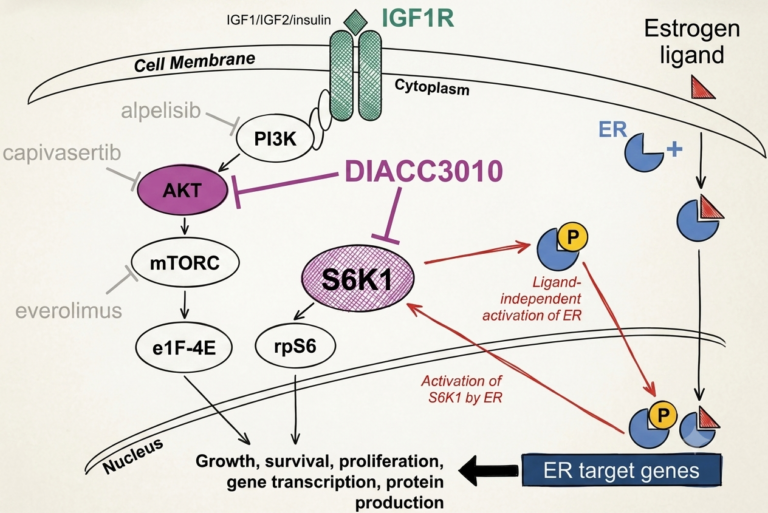
Background: In resistant breast cancer, ribosomal protein S6 kinase (S6K) is a key regulator of estrogen receptor (ER) function, and its high expression is associated with poor clinical outcomes in breast cancer (BC). Recent data have demonstrated that S6K is involved in resistance to CDK4/6 inhibitors in metastatic BC (MBC). DIACC3010 (formerly M2698) is an oral brain-penetrant potent inhibitor of S6K. By design, DIACC3010 also selectively inhibits AKT1 and AKT3, while sparing AKT2. DIACC3010 was previously evaluated in a phase 1 trial (NCT01971515). We performed exploratory correlative analyses of the phase 1 trial in ER+ HER2-negative MBC patients in addition to nonclinical experiments to evaluate its role in the CDK4/6 and endocrine therapy (ET) resistant setting.
METHODS
DIACC3010 was evaluated as monotherapy, or combined with either trastuzumab or tamoxifen, in a multicenter phase 1 trial that accrued 101 patients with advanced/refractory resistant breast cancer (1). The current analysis focused on patients with ER+ HER2-negative MBC and aimed to explore the efficacy of DIACC3010 according to ESR1 mutational status. DIACC3010 was also evaluated patient-derived xenograft (PDX) mouse models, in monotherapy and combined with tamoxifen or palbociclib, and in xenograft models alone and in combination with elacestrant or abemaciclib.
RESULTS
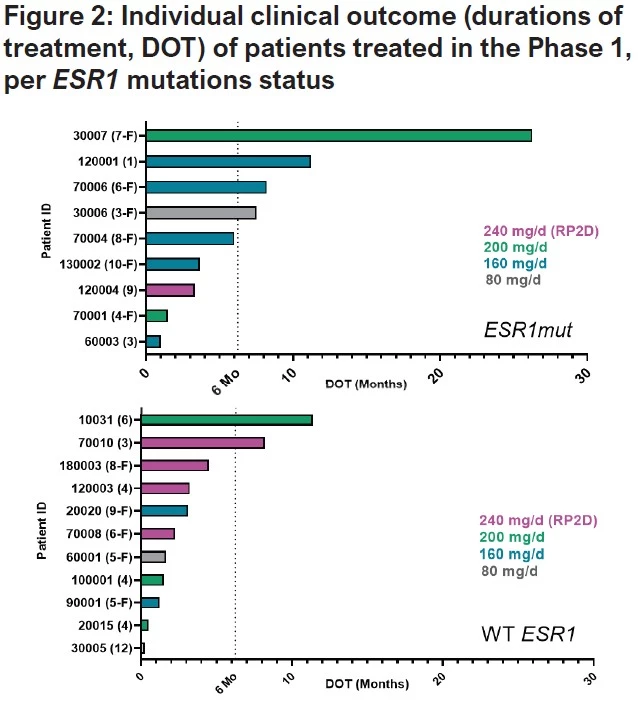
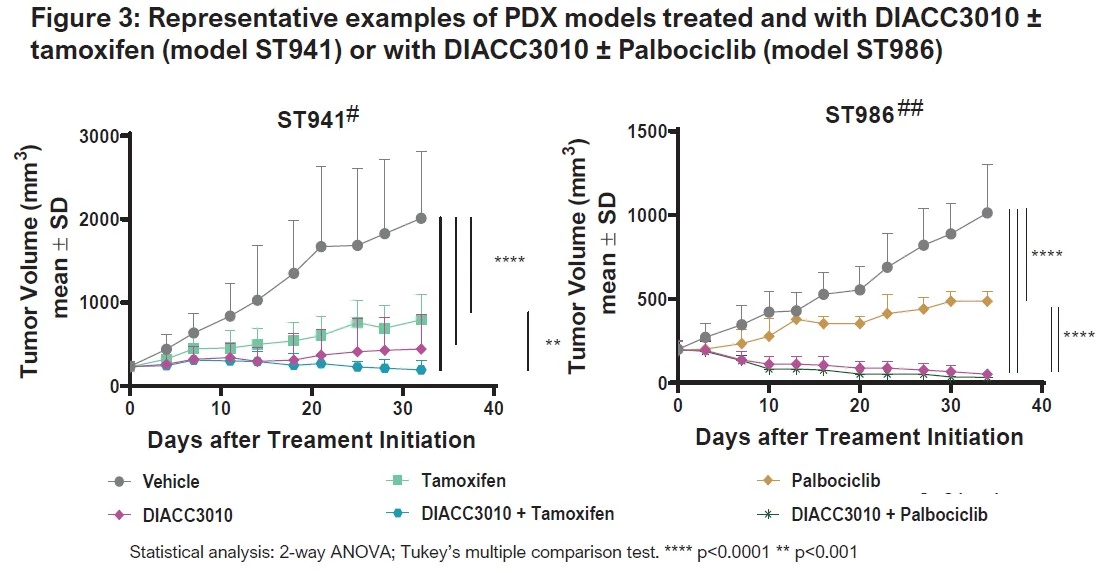
Twenty patients were evaluable at baseline for their tumor mutational status and included in the analysis. Median age was 60 years and median number of prior lines of therapy was 5.5. Twelve of 20 (60%) patients had received prior treatment with CDK4/6 inhibitors. Nine of 20 patients (45%) had ESR1 mutations, of whom 4 had received CDK4/6 inhibitor. Median progression free survival was 5.6 months in patients with ESR1 mutations, and 2.6 months in patients with ESR1 wild-type tumors. Among the 13 ER+ BC PDX models evaluated, 12 provided interpretable results. The combination of DIACC3010 with tamoxifen or palbociclib induced respectively 10/12 (83%) and 11/12 (92%) significant tumor growth control in PDX models, of which 42% were resistant to tamoxifen and 50% were resistant to palbociclib. The combination of DIACC3010 with elacestrant or abemaciclib induced respectively 77% and 75% significant tumor growth control in MCF7 xenograft model. Furthermore, DIACC3010 monotherapy resulted in significant tumor growth control in 3/5 (60%) of the tamoxifen-resistant PDX models and 5/6 (83%) of the Palbociclib-resistant PDX models.
Patients (N = 101) with advanced resistant breast cancer (relapsed/refractory metastatic solid tumors) were enrolled in a large Phase 1 trial (1). The trial comprised DIACC3010 dose-escalation in monotherapy followed by multiple cohort expansions (1).
The current analysis focuses on the combination cohort of DIACC3010 and tamoxifen in resistant breast cancer (refractory ER+ HER2- metastatic cancer).
Prior anticancer therapies included palbociclib, everolimus, fulvestrant and other endocrine therapies.
DIACC3010 alone and in combination with tamoxifen or palbociclib was tested in a panel of 12 breast cancer Patient-Derived Xenograft (PDX) models.
Six- to 12-week-old female athymic Nude mice (n=4 mice per group) were implanted subcutaneously (SC) with 70 mg tumor fragment.
Dosing regimen, with all drugs administered per os (PO) and daily were:
– DIACC3010 25 mg/kg & tamoxifen 3 mg/kg, n=10 models (#)
– DIACC3010 25 mg/kg & tamoxifen 5 mg/kg, n=2 models
– DIACC3010 30 mg/kg & tamoxifen 1 mg/kg, n=1 model
– DIACC3010 25 mg/kg & palbociclib 40 mg/kg, n=9 models
– DIACC3010 25 mg/kg & palbociclib 75 mg/kg, n=3 models
– DIACC3010 30 mg/kg & palbociclib 75 mg/kg, n=1 model (##)
Five out of 12 PDX models were found resistant to tamoxifen (42%) and 6 were found resistant to palbociclib (50%) (both drugs had no anti-tumor activity as compared to vehicle).
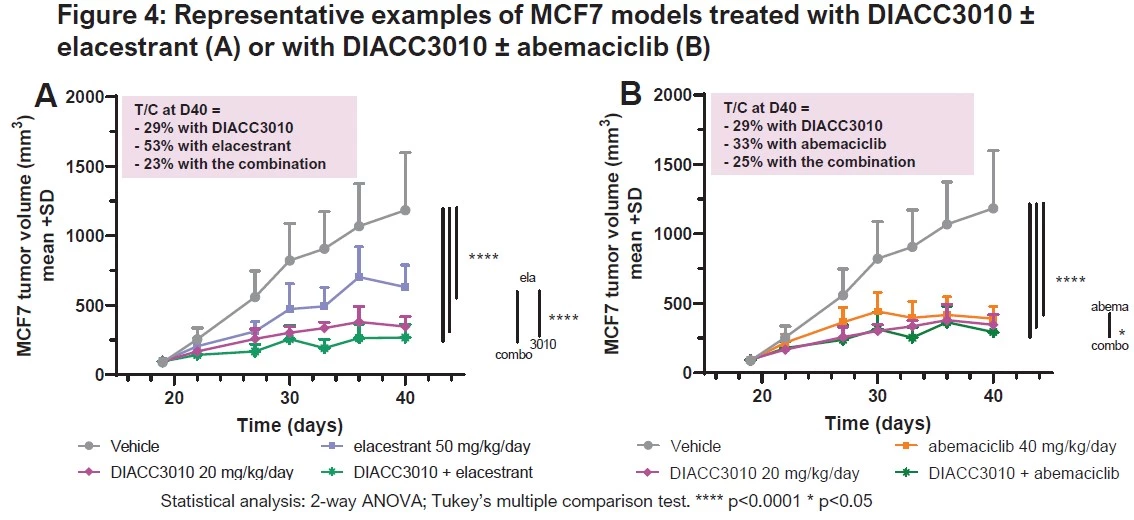
DIACC3010 alone and in combination with elacestrant or abemaciclib were tested in MCF7 human breast cancer (ATCC purchased) xenograft in Nude mice.
D-1: Mice were implanted with 0.18 mg b-estradiol containing pellets.
D0: mice were injected with 5.106 cells in 200 μl PBS:Matrigel (50:50).
Treatments started on D19 (tumor vol. ~100 mm3) with all drugs administered PO once daily for 21 days (n=8 mice/group), with the doses presented in Fig. 4.
DIACC3010 induced 71% MCF7 tumor growth inhibition as compared to vehicle, more potently than elacestrant (47%) (Fig. 4.A) and as efficiently as abemaciclib (67%) (Fig. 4.B).
CONCLUSION
These exploratory analyses from the phase 1 trial, along with nonclinical efficacy in monotherapy and in combination with standard treatments in various models of breast cancer, support further clinical development of DIACC3010 in ER+ HER2- metastatic or resistant breast cancer.
A randomized Phase 2/3 study in combination with endocrine therapy will be conducted in the near future.
REFERENCES
1. AM Tsimberidou et al, J Hematol Oncol 2021 14(1):127
2. M Artemenko et al, Cancer Letters 2022 535(21):5593
3. RL Yamnik et al, J Biol Chemistry 2009 284(10):6361
4. H. Mo et al, Mol Cancer 2022 21(1):171
Download the poster here: posterAACR 2023 – DIACC3010_final
Contact our Team to learn more
FAQ
Ribosomal protein S6 kinase (S6K) functions as a regulator of estrogen receptor (ER) activity in resistant breast cancer. Elevated expression of this protein is connected with unfavorable clinical outcomes in patients. High level of S6K is also implicated in resistance against CDK4/6 inhibitors during metastatic disease. The compound DIACC3010, previously designated as M2698, was created as an oral, brain-penetrant agent that inhibits S6K. In addition to suppressing S6K, DIACC3010 selectively inhibits AKT1 and AKT3. Meanwhile, AKT2 is spared by the molecule. Correlative analyses and nonclinical studies were conducted to assess DIACC3010 in setting of resistance to CDK4/6 inhibitors and endocrine therapy.
In a multicentre phase 1 study (NCT01971515), DIACC3010 was tested in 101 individuals presenting advanced or refractory resistant breast cancer. The agent was delivered as monotherapy or combined with either trastuzumab or tamoxifen. A sub-analysis focused specifically on patients with ER+ HER2-negative metastatic disease to evaluate efficacy based on ESR1 mutational status. Evaluated subjects had a median age of 60 years and had received a median of 5.5 prior therapy lines. Sixty percent of these patients were previously treated using CDK4/6 inhibitors. Mouse patient-derived xenograft (PDX) and xenograft models were additionally tested using DIACC3010 alone or alongside tamoxifen, palbociclib, elacestrant, or abemaciclib.
Twenty patients were evaluable for baseline tumor mutational status in the analysis. ESR1 mutations were detected in nine of these individuals, four of whom had prior exposure to CDK4/6 inhibitors. A median progression-free survival of 5.6 months was reached in patients harbouring ESR1 mutations. In contrast, a median progression-free survival of 1.8 months was observed in patients without ESR1 mutations. Extended disease control was maintained in two subjects with ESR1 mutations for periods exceeding 11 months and 24 months. These clinical observations suggest potential activity of DIACC3010 in mutational settings.
In mouse models of resistant breast cancer, strong antitumor activity was demonstrated when DIACC3010 was combined with endocrine therapies or CDK4/6 inhibitors. Nonclinical experiments evaluated PDX and xenograft models using single-agent treatments or combination regimens. Tumor growth was inhibited more effectively by combined regimens compared to single agents. DIACC3010 was combined with tamoxifen or palbociclib in PDX models. In addition, combinations with elacestrant or abemaciclib were assessed in xenograft models. Enhanced regression of tumors was achieved through dual inhibition of S6K and estrogen receptor signaling pathways.
The small molecule DIACC3010 was designed to inhibit S6K. Target selectivity was incorporated to inhibit AKT1 and AKT3 isoforms. Conversely, AKT2 activity is preserved without suppression. S6K serves as a regulator for estrogen receptor function in resistant breast cancer. In target tissues, brain penetration is achieved by oral administration of the molecule. In phase 1 clinical trials, this inhibitor was studied in patients with advanced resistant breast cancer. Nonclinical studies verified that targeted enzyme inhibition alters signaling pathways involved in therapy resistance.
In the clinical trial analysis, ESR1 mutational status was evaluated in twenty ER+ HER2-negative patients. Longer median progression-free survival was recorded for patients carrying ESR1 mutations than for patients with wild-type genes. Nine patients in the cohort presented ESR1 gene alterations. Among these nine subjects, four had previously undergone treatment with CDK4/6 inhibitors. Disease control lasting beyond 11 months was attained by two individuals carrying the mutation. These results indicate that presence of ESR1 mutations may influence therapeutic response to DIACC3010 in resistant breast cancer.
The combination of DIACC3010 with endocrine therapy or CDK4/6 inhibitors was evaluated in clinical trials and nonclinical models. In the phase 1 study, tamoxifen or trastuzumab was combined with DIACC3010 in patient groups. In mouse xenograft models, combinations involving palbociclib, abemaciclib, or elacestrant were tested. Potent antitumor responses were produced when S6K suppression was combined with endocrine targeted therapies. High S6K levels are linked to resistance against CDK4/6 inhibitors in metastatic disease. Combined treatment strategies are designed to counter resistance mechanisms in resistant breast cancer.
Patients enrolled in the phase 1 trial presented advanced or refractory disease. A median number of 5.5 prior lines of therapy had been administered to the evaluable patient cohort. CDK4/6 inhibitors had been received by 12 out of 20 patients prior to study entry. Within the subgroup of nine patients with ESR1 mutations, four had previously received CDK4/6 inhibitor therapy. Heavy pre-treatment reflects an advanced stage of resistant breast cancer in the study population. Efficacy exploratory analyses were performed despite extensive prior therapeutic exposure.
Nonclinical experiments using mouse models provided evidence supporting clinical observation in ER+ HER2-negative disease. PDX models were treated with DIACC3010 as single agent or combined with tamoxifen or palbociclib. Xenograft models were tested using DIACC3010 alone or in combination with elacestrant or abemaciclib. Antitumor activity was observed across these models. The data correlate with clinical outcomes recorded in patients with resistant breast cancer. Molecular target inhibition in models supported the hypothesis regarding S6K involvement in therapy resistance.
