

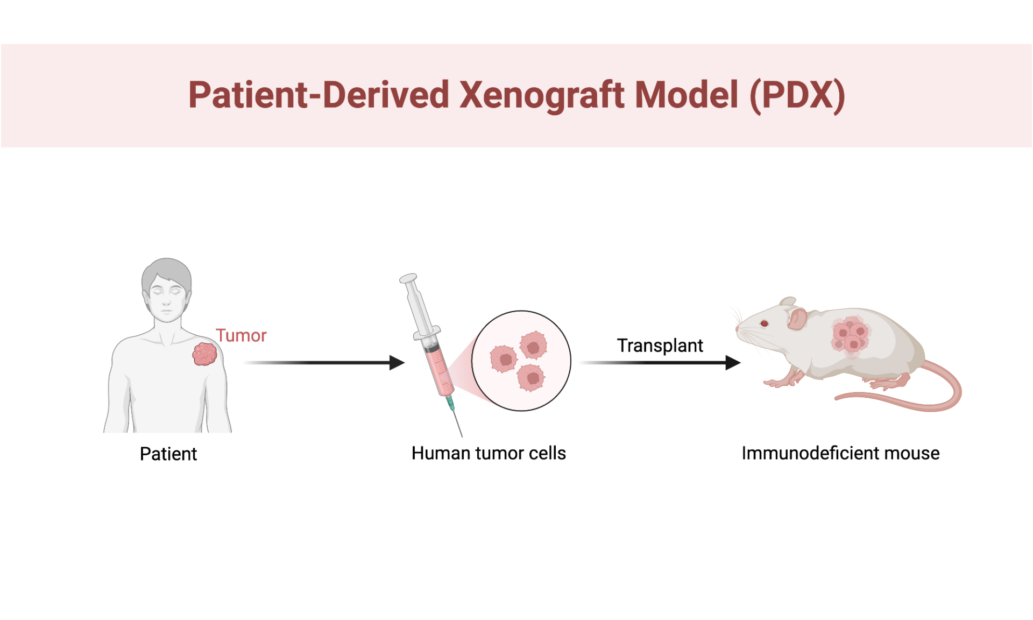
Patient-Derived Xenograft (PDX) models are built directly from primary human tumour tissue: a fragment of surgically resected tumour is implanted into an immunocompromised mouse, either subcutaneously or orthotopically. Unlike cell line-based models, PDX are never cultured in vitro before implantation, preserving the genomic, phenotypic, and architectural features of the original patient tumour across successive passage.
Passage numbers are kept deliberately low to limit host adaptation and maintain the model as close as possible to the primary tumour.
For most of our PDX, a clinical history is available. It enables the selection of tumours from patients who have already received prior lines of therapy, which is particularly relevant to test a novel medication intended for use in the event that first-line therapy is unsuccessful.
Why PDX models?
-
Closer to clinical reality
PDX models retain the key mutations, gene expression profiles, histological architecture, and tumour heterogeneity of the original patient sample. This makes them substantially more predictive of human clinical responses than standard cell line models. Particularly for targeted therapies and resistance studies.
-
Access to clinical context
PDX models maintain the tumor heterogeneity seen in patients, which is critical for studying the complexities of cancer, including rare subpopulations of cells that might drive resistance to therapy. For most PDX in our collection, clinical history data is accessible, including prior treatment lines. This allows study designs to mirror real patient populations. For instance, selecting tumours from patients who relapsed after first-line therapy to test a second-line candidate.
-
Evaluation of novel and combination therapies
PDX models provide a robust platform for testing targeted therapies, immunotherapies, chemotherapy combinations, and emerging modalities. Their heterogeneity makes them particularly informative for identifying the most promising therapeutic candidates, predict patient responses, resistance subpopulations and biomarker-driven response patterns.
-
Humanized models for immuno-oncology
While PDX models are typically created in immunocompromised mice, recent advances allow them to be combined with human immune cell engraftment, creating humanized PDX systems. These are particularly valuable for evaluating immunotherapies, such as immune checkpoint inhibitors and studying tumour-immune interactions in a patient-relevant context.
-
Cryopreservation for longitudinal studies
Tumour fragments from each passage can be cryopreserved for future studies. This enables models to be re-established for follow-on studies thus preserving continuity across experimental series and reducing lead time for repeat experiments.
To learn more about our PDX offerings or to discuss your specific research needs, please contact us.
